
NewAllen
Priorities

Regional
Context

Board
of Directors

NewAllen
Rural Liaison

Community
Collaborators

NewAllen
History

NewAllen
FAQ


NewAllen Alliance supports the development of communities in a way that is effective, responsible and strategic. This will be accomplished through the proactive management of growth in addition to advancing a community and economic development approach relevant for rural and suburban communities.
Strategy: Manage Growth and Development
Strong leadership and structure provides a foundation for successful development that is responsive to community desires. Although the New Allen communities have varying levels of leadership capacity, each has identified strategies by which to build and empower themselves to support and sustain community and economic development (C&ED) projects. From incorporation to developing community foundations and Main Street organizations to creating tax increment financing districts, communities may cultivate their abilities to affect change and accomplish identified goals through community engagement and the establishment of funding mechanisms.
As NewAllen Alliance communities also seek to improve regulations in order to influence the quality of new development, it is acceptable to place certain expectations on the community and neighborhood developers as projects occur. Zoning ordinances, which control the use of land and buildings, often focused on a separation of land uses. This approach is easier to implement, but can lack flexibility and now is considered to be somewhat outdated. Newer methods provide more latitude, concentrating less on the type of use of land and more on the form that land use may take. For example, elements such setbacks, density and accessibility are regulated in a manner to allow for more walkable, adaptable environments. Both Allen County and the City of Fort Wayne have updated their zoning ordinances in recent years to reflect more modern zoning practices. Incorporated NewAllen communities are also interested in updating their ordinances to influence quality development without creating an excessive burden onto property owners.
Strategy: Advance a Rural and Suburban Community and Economic Development Approach
The field of economic development, which used to focus primarily on the attraction and retention of industry, has evolved to include small business development, workforce development, and quality of life initiatives. The lines between community development and economic development have become blurred, and the responsibility for these activities throughout Allen County can be confusing. Cities, towns, community associations, local chambers of commerce, East Allen County Schools (EACS), the New Allen Alliance, Allen County Commissioners and Council, Allen County Department of Planning Services, Greater Fort Wayne, Inc., the Northeastern Indiana Regional Coordinating Council and several other stakeholders and organizations each play valuable roles in advancing initiatives in Allen County's rural communities.
Although Allen County is an urban county and includes the City of Fort Wayne, Indiana's second largest city by population, a significant portion of the county is still rural. According to ESRI Community Analyst data provided by the IPFW Community Research Institute, the 2013 population represented by the coverage area of NewAllen Alliance is 56,491. This is 15.7% of the county's 2013 population of 360,269, and is larger than 65 of Indiana's 92 counties according to 2011 U.S. Census estimates. When adding in the population of the other Allen County rural areas that aren't within the NewAllen Alliance coverage area, the amount of rural and suburban residents and territory is significant enough to validate a dual, mutually beneficial urban and suburban/rural approach to C&ED throughout Allen County.
Traditionally, the approach to C&ED within the rural and suburban areas of Allen County has been reactive. Due to the size and dynamic nature of the City of Fort Wayne, a significant focus has been directed to this urban area. While this is understandable, it is also apparent to New Allen Alliance communities that a void exists in regard to the level of attention and assistance given to them. Rural and suburban areas need a more attentive, proactive approach that helps to cultivate the respective communities so they can more effectively reach their goals.The NewAllen Alliance desires to work with Allen County C&ED agencies and organizations on the following:

NewAllen Alliance communities identify NewAllen Alliance communities identify themselves as being small, rural, friendly and family-oriented. Future growth and development should allow for the retention of these characteristics while creating healthy, thriving communities. Quality of place investment strategies include preserving and capitalizing upon authentic heritage, revitalizing downtowns, and improving the quality of and access to parks.
Strategy: Preserve and Capitalize Upon Authentic Heritage
Economic development strategies should be aligned with a community's identity, which, if not already established, should be based upon area attributes that have previously or currently exist. This identity can be supported through the preservation of places and buildings that reflect historical context. Public spaces, shops, design, as well as signs and logos can then reflect the established identity in an effort to promote heritage tourism. The NewAllen Alliance communities each have several qualities to build upon including agricultural heritage, Amish culture, proximity to rivers, and transportation history including canal, rail and the Lincoln Highway.
An additional source of identity and pride for NewAllen Alliance communities is the belief that each is a great place to live. While there are several aspects that can be improved upon to enhance livability, the communities provide a valuable contribution to the larger, regional goal of attracting and retaining a talented workforce. Although the City of Fort Wayne is the economic hub for jobs, commerce and housing, rural Allen County communities provide an alternative place to live for people interested in being part of a small community while also having easy access to the center of a metropolitan area.
Identity is something that needs to be established and articulated within each community so that individuals, groups and organizations can support and promote the concept. The NewAllen Alliance desires to develop a collaborative branding and marketing strategy that promotes both the individuality and the commonality of the NewAllen area. This strategy will build alignment within communities and awareness throughout Allen County and the Northeast Indiana region.
Strategy: Promote Identity and an Improved Quality of Life through Investment in Centers of Activity
Downtowns: Downtowns are most often the genesis of any community. They originated due to being a central, strategic location near roadway crossroads, a railroad stop, a canal passage or a riverside settlement. They are often historic, compact, and are places of commercial, institutional and residential use where infrastructure and public services are already in place. It makes sense to reinvest into downtown areas as opposed to allowing for its deterioration in favor of new development and sprawl on the outer perimeter of the community.
Investing in downtowns improves the quality of life of a community through the preservation of a sense of place. Revitalized downtowns portray economic vitality, progressiveness, and civic pride which provide a positive image to those seeking to live, visit, or do business within the community. Downtown design can be varied and complex in consideration of uses, density, streets, alleys, parking, buildings, signage, public spaces, art, infrastructure and utilities. The assistance of a landscape designer and/or engineer is often needed to create a dynamic, pedestrian experience.
The National Trust for Historic Preservation developed the Main Street program, which focuses on the elements of organization, promotion, design, and economic vitality, to help local communities revitalize their downtowns. Indiana communities can form local Main Street organizations with the assistance of the Indiana Office of Community and Rural Affairs and each of the NewAllen communities are exploring participation in this program.
Parks: According to the National Recreation and Park Association (NRPA), parks and recreation are essential public amenities offering economic value, health and environmental benefits, and social importance to a community. Among the many benefits of parks, they improve the local tax base and increase property values, are often cited by businesses as a primary reason for relocation, and provide indirect revenues to local and regional economies from sports tournaments and special events such as arts, music, and festivals. Parks help to improve water quality, protect groundwater, prevent flooding, improve air quality, provide wildlife habitats, and contribute to the physical health of the community residents. From a social perspective, the availability of parks and recreation services is often cited as a major factor in community livability surveys, has been strongly linked to reductions in crime and juvenile delinquency, and provides a sense of public pride and cohesion.
Communities are often benchmarked by how many acres of parkland there is per capita, and ensuring the adequacy of park facilities for the population is a function of planning, zoning, and development guidelines. The Indiana Statewide Comprehensive Outdoor Recreation Plan 2016-2020, published in December 2015, recommends that there be 20 acres of public land per 1,000 people for local parks (County, Township, City, or Town-owned). In Allen County, that amounts to a need of 7,318.36 acres. As the current acreage is 6,228.69, it's clear that the County is at a deficit. In addition, the Allen County Parks and Recreation 2013-2017 Master Plan has identified an area of southeast Allen County encompassing Woodburn, Monroeville, and Hoagland as being in need of additional park land and new facilities.
Throughout the planning process, each NewAllen community identified park rehabilitation and development as a priority. Even for those communities with adequate park acreage, the facilities are often aged, in disrepair, do not meet ADA requirements, and/or do not have safe, walkable passages leading to the park from surrounding residential areas.
Tying Together Heritage Branding, Downtown Revitalization, and Park Improvements for Maximum Benefit: The NewAllen Alliance will lead an initiative that ties together individual and collective community heritage identification, downtown streetscape enhancements, and local community park improvements throughout East Allen County based on a collective branding program and quality, landscape design.
In the late 1800s and early 1900s, large and mid-sized cities across the U.S. established large park systems that included parks, parkways and boulevards. For example, the City of Fort Wayne's Park and Boulevard System, designed by landscape architect George Kessler between 1911 and 1912, is on the National Register of Historic Places. Louisville, Kentucky's Parks and Parkways were designed in 1891 by Frederick Law Olmsted, the renowned landscape architect for such places as Central Park in New York City, the U.S. Capital Building, and the Biltmore Estate in Ashville, North Carolina.
Although the practice of designing large park systems has all but disappeared, in 2005, Louisville embarked upon an ambitious plan to build off of Olmsted's work by adding thousands of acres of park land and greenspace into a "greenprint" of the metropolitan area. The initiative involved the acquisition and development of new park land, trails and open spaces on the edge of the city, and the over 100-miles long Louisville Loop shared-use path that ties together parks and neighborhoods, outdoor recreation and nature education programs.
There are many examples by which county-wide park systems have established a commonality through the use of design elements and signage. However, tying together well-established individual communities by a collective identity using gateways, downtown streetscapes, and park improvements is somewhat unique. Such an initiative can be supported through the establishment of collaborative contracts for goods and services for downtowns and parks among communities and Allen County. A focus on safe, accessible sidewalk, trail, and bike lane connectivity both within and between the individual NewAllen Alliance communities, to include links to downtowns and parks, will enhance the experience and overall investment.

The quality of a community as a good place to live is embodied by the availability of amenities such as parks, walkable neighborhoods, access to essential services and retail shops, restaurants, and social activities, all of which may be addressed under Priority #2. Healthy, thriving communities must also provide a foundation built upon having a range of quality housing options at a variety of price points, as well as adequate built and civic infrastructure to support both existing and future development.
Strategy: Provide a Range of Quality Housing Opportunities
While each NewAllen Alliance community has its own unique demographics and housing needs, they all have a need to rehabilitate existing, aging housing stock. NewAllen Alliance communities are also interested in promoting the development of senior housing options that are affordable, accessible, easy to maintain, and safe. US Census population projections show that Allen County's senior population (65+) will increase from 10.9% in 2010 to 18.9% in 2030. When a variety of housing alternatives are available, seniors can continue to live within their communities of choice while opening up single-family housing opportunities for younger families.
Several of the communities also desire new housing options. Housing vacancy rates within NewAllen communities ranges from 0% to 11%, with four communities having less than 4% vacancy indicating a general need for more housing. The New Allen Alliance is interested in exploring and promoting quality residential development design that can differentiate its communities from surrounding urban areas. Development standards that allow for outbuildings such as garages and mother-in-law suites that architecturally complement the primary residence, and the development of pocket neighborhoods (clustered groups of small houses or apartments spaced around a shared open area) are both concepts that can be explored.
Strategy: Provide Adequate Infrastructure
The NewAllen Alliance strongly supports improved access to broadband throughout rural Allen County. According to the Federal Communications Commission (FCC), the term "broadband" refers to high-speed internet access that is always on. It is transferred by a variety of transmission technologies such as digital subscriber line (DSL), cable, fiber optic, and satellite by internet service providers (ISPs). Broadband speed, measured in megabits per second (Mbps), refers to the rate at which information is downloaded from, or uploaded to, the internet. Broadband is essential to supporting economic development, innovation, jobs, and global competitiveness, and ensures access to things like educational materials, telemedicine, and employment and community resources. In 2015, the FCC raised the standard for minimum download speeds to 25Mbps and minimum upload speeds to 3Mbps. Due to these changes, 13.1% of US households don't have access to broadband service capable of providing the standard parameters. A significant portion of East Allen County falls into this category.
Decentralized regulation of broadband infrastructure adds complexity in regard to how to obtain improved access to infrastructure. NewAllen supports a collective initiative that can establish an approach to priorities, cost, and funding throughout East Allen County.
Each community also has its own individual transportation, water and sewer needs. In particular, it will be important for individual communities to understand their capacity limitations in regard to water and sewer in order to support the development that they desire. This may require additional individual study based on growth scenarios.
Strategy: Engage and Connect to Support Investments
In order for the NewAllen Alliance Strategic Investment Plan (SIP) to be effective, the NewAllen Strategic Advancement Committee will be established by the New Allen Alliance to provide oversight and ownership in regard to the implementation of collaborative and individual community initiatives. Committee representation will be requested of those who have participated on the community and stakeholder committees throughout the SIP process. Meetings will be held on a quarterly basis. The New Allen Alliance will also seek out opportunities by which to continue to build the leadership capacity of participating communities through volunteer recruitment and leadership development activities.
It is also the desire of the NewAllen Alliance, in collaboration with Allen County, to hire a Community Development Liaison to provide organizational support of the identified initiatives. This position will coordinate with C&ED agencies and stakeholders throughout Allen County and will provide proactive leadership in the implementation of the SIP.
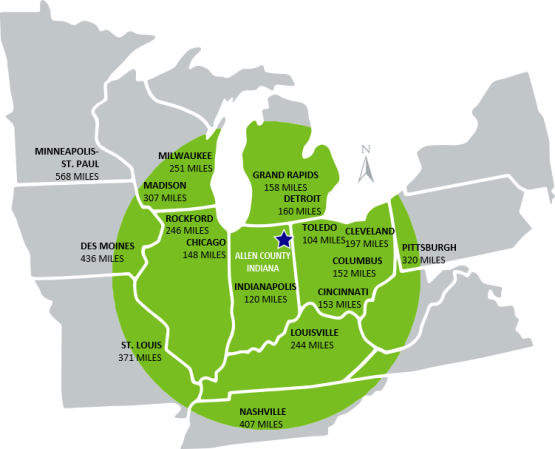
NewAllen Alliance communities are situated in the eastern portion of Allen County, the area is next to the City of Fort Wayne, Indiana's second-largest city. Allen County is in the northeastern corner of the State of Indiana, a region with a population of approximately 700,000 that is within a two-to-three hour drive from major Midwest cities such as Chicago, Detroit, and Indianapolis.
The population of the area served by the New Allen Alliance is 56,491 which is approximately 16% of Allen County's population of 360,259 according to ESRI Community Analyst data for 2013 provided by the IPFW Community Research Institute. This population is also larger than that of 65 of Indiana's 92 counties. The NewAllen area has 20,124 households and 21,496 housing units with a 6.4% vacancy rate. Top industries by employee are Manufacturing, Wholesale and Retail, and Education & Health Services.
Kristi Sturtz, ALM, AICP has twenty-five years of experience as a Community and Economic Developer. As the owner of Sturtz Public Management Group, she has worked with several organizations and communities throughout the State of Indiana on a range of types of projects including Collaboration, Quality of Life, Neighborhood Livability, Downtown Revitalization, Comprehensive Planning, Annexation, Infrastructure Development, Sustainability Planning, and Strategic Fund Development.
Kristi is a Master of Liberal Arts Degree Candidate for Development Practice at Harvard Extension School. She also has a Bachelor of Science degree in Public Affairs with a concentration in Public Management from the School of Public and Environmental Affairs at Indiana University. Kristi is a member of the American Institute of Certified Planners, a Qualified History Professional with the Indiana Department of Natural Resources, and an accredited Grant Administrator for the Indiana Office of Community and Rural Affairs.

Nelson Peters, Allen County Commissioners
Marilyn Hissong, East Allen County Schools
Adam Welch, Greater Fort Wayne, Inc.
Tracey Davis, Ivy Tech Community College
Dana Berkes, NIPSCO
Nick Darrah, Northeast Indiana Regional Partnership
Matt Vondran, Northeastern Indiana Regional Coordinating Council
AEP
CITY OF NEW HAVEN
CITY OF WOODBURN
FIRST MERCHANTS BANK
GRABILL CHAMBER OF COMMERCE
HARLAN COMMUNITY ASSOCIATION
HOAGLAND CHAMBER OF COMMERCE
INDIANA-MICHIGAN POWER
JEFFERSON TOWNSHIP TRUSTEE
LEO-CEDARVILLE FOUNDATION
MAUMEE TOWNSHIP TRUSTEE
MILAN CENTER FEED & GRAIN INC
MONROEVILLE CHAMBER OF COMMERCE
NEW HAVEN CHAMBER OF COMMERCE
PAULDING-PUTNAM ELEC CO-OP
SDI LAFARGA, LLC
THREE RIVERS FEDERAL CREDIT UNION
TOWN OF GRABILL
TOWN OF LEO-CEDARVILLE
TOWN OF MONROEVILLE
UPSTATE ALLIANCE REALTORS
President
Tim is lifelong resident of southeast Allen County and an active leader in local community organizations and professional associations. He is a graduate of Heritage High School and Indiana University, and also a graduate of Leadership Fort Wayne. Tim works as an appraiser and is the owner of Capitale Analytics, a small business valuation company.
Vice-President
Lindsey is a lifelong resident of the greater Leo-Cedarville community and leads the Leo-Cedarville Foundation. Lindsey works as a Copy Editor at Destiny Rescue, working to rescue children from human trafficking around the world. Lindsey’s a firm advocate for our local communities and serves on numerous boards in the area, including serving as the NewAllen Alliance’s representative on the Greater Fort Wayne, Inc. board, as President of the Leo-Cedarville Foundation, as a board member for the Fort Wayne Civic Theatre and as a community development advisory committee member for Purdue Extension - Allen County.
Treasurer
Kevin is a lifelong Grabill area resident. He was raised on his family's Hoosier Homestead farm which has been in the family since 1853. Kevin currently serves as Vice President at First Merchants Bank specializing in business lending. He is a graduate of International Business College. He serves his community as a member of Grabill Missionary Church, a board member for the Grabill Chamber of Commerce & Grabill Development Corporation, and the local chapter of Growing Hope Globally.
Board Member
Tammy Taylor is a lifelong Allen county resident who has lived in both Woodburn and New Haven. She has a military veteran family. Tammy has a Bachelor of Science in Business Marketing (Indiana University- IPFW) and a Master of Science in Communication (Purdue University). She participated in the Leadership Fort Wayne Class of 2022. She volunteers regularly and has been employed by the New Haven Chamber since August of 2022.
Board Member
Herb is a lifelong resident of Allen County and has lived in the city of Woodburn for over 30 years. He retired from BF Goodrich after 45 years in 2020. He is a member of USW Local 715 and has been a long-time volunteer with the United Way of Allen County, currently as an emeritus member of the Board of Directors and a member of their finance committee. Herb is also a member of the Board of Directors for Financial Partners FCU, serving as the Chair. He enjoys working in his yard, doing woodworking projects and traveling as often as he can.
Board Member
A lifelong resident of Harlan-Woodburn area, Sally has been involved with the Harlan Community Association since 2000. She started working as a volunteer, eventually serving six years as Food Tent Chair. She then served seven years as Chair of Harlan Days and two years as the Vice-President of the Harlan Community Association. Sally became president of the Harlan Community Association in 2018. Her goal is to involve town residents to help improve Harlan and the Community Park.
Board Member
Dan is a lifelong resident of Southeast Allen county. He is a graduate of Heritage High School in 2000. Dan was the assistant superintendent for the Town of Monroeville from 2012, and took on his current position as Superintendent in 2021. He is married and loves spending most of his free time coaching/running around their three boys. They have lived in Monroeville for the last 17 years.